
- The one thing that really separates two pairs of compression boots is how the chambers are arranged: six overlapping chambers beat eight separate ones, because no band of the leg is left without compression.
- Second criterion, the pressure range. A wide range, in the order of 40 to 260 mmHg, lets you start gently and work upwards; a device capped around 100 mmHg runs out of room after a fortnight.
- Sizing is the leading cause of disappointment in this market, across every brand, and it is decided by inseam length, never by thigh circumference.
- Battery life, noise level and the type of closure decide whether the device is actually used: a noisy, mains-bound or awkward device ends up in a cupboard whatever its specifications say.
- Price markers: under 200 euros, separate chambers and limited pressure; around 600 euros, the professional specifications; 1,200 to 2,500 euros for the machines installed in clinics and salons.
Choosing compression boots is uncomfortable for one precise reason: in photographs, every product looks the same. Grey boots, a controller with a screen, a sales pitch promising drainage, and prices running from 150 euros to more than 2,500 euros without any obvious explanation for the gap.
Yet three or four specifications account for the entire difference in use, and they are almost never put forward, because they do not photograph well. This guide ranks them in order of real importance, explains how to verify each one before buying, and sets out what you actually get in each price bracket. Everything here applies whether the product is sold as compression boots, recovery boots, a leg compression machine or an at-home lymphatic drainage massage.
Which compression boots should you choose?
The one whose chambers overlap, whose pressure range reaches at least 200 mmHg, and whose size matches your inseam length. Once those three points are settled, everything else is comfort of use and falls into line behind them: battery life, noise, closure, warranty.
Put another way: a badly sized device, or one with separate chambers, will never be rescued by a handsome touchscreen or a tenth programme. Here are the criteria in the order in which they count.
| Rank | Criterion | What to check |
|---|---|---|
| 1 | Chamber arrangement | Overlapping chambers, partially covering each other, rather than sitting side by side. The number on its own tells you nothing. |
| 2 | Pressure range | A wide span, in the order of 40 to 260 mmHg, adjustable in steps. |
| 3 | Size and length | A size chosen on inseam length, with a stated solution if the thigh is wide. |
| 4 | Battery life | Battery rather than mains power, and a capacity that covers several sessions between charges. |
| 5 | Noise level | Under 40 decibels, so a session can run through a film without turning the volume up. |
| 6 | Type of closure | A full-length zip that does not slacken over time. |
| 7 | Warranty and markings | Two years of warranty, CE, ISO and ROHS markings, and someone who answers the phone. |
| 8 | Programmes and timer | A handful of useful programmes and a wide timer, 10 to 90 minutes. Beyond that it is specification inflation. |
Overlapping chambers or separate chambers: what changes?
With overlapping chambers, the compression zones partially cover one another, the wave travels up without interruption and no portion of the leg is left unpressed. With separate chambers, a band remains between each one that compression never touches, and the wave is broken into pieces.
This is the most important technical difference between two devices at the same price, and it is also the least visible on a product page. It explains a sensation many people describe without being able to name it: the feeling of jumps during the cycle, the impression that the pressure stops and then resumes higher up, instead of rising in a single movement.
The commercial trap comes down to one thing, the number. A device advertised as eight chambers is no better than a six-chamber one if the eight sit side by side and the six overlap. A figure is easy to print on a box; overlap is not. When the information appears nowhere, ask the seller directly: a brand that designed its sleeves with overlap knows it and says so in one sentence. An evasive answer is an answer.
What pressure range should you aim for?
A wide one, in the order of 40 to 260 mmHg, because your needs change over time and with use. Pressure is measured in millimetres of mercury, and it is the only figure on the specification sheet that compares directly from one device to the next.
The bottom of the range is for the beginning. The first two weeks happen between 80 and 120 mmHg, long enough to get used to the sensation and to check that the compression is comfortable.
The top of the range is for later, and for other purposes. In everyday wellness use, most people settle between 120 and 180 mmHg. For recovery after a long effort, you go higher. A device capped around 100 mmHg leaves no headroom at all: the sensation stays superficial and there is nothing left to adjust after a month.
Check as well that pressure is adjustable in readable steps, and that it is displayed. A device offering low, medium and high with no numbers makes it impossible to know where you are, or to find again the setting that suited you.
Why is sizing the leading cause of disappointment?
Because a sleeve that is too short slides downwards as it inflates, and part of the compression is lost instead of being transmitted to the leg. The result is a technically sound device that feels as though it does nothing, which is the worst possible outcome for buyer and seller alike.
The misunderstanding comes from the criterion used. Many product pages give a size by thigh circumference, sometimes by body height, and both are misleading. It is inseam length that decides, measured standing, feet flat, from the floor up to the groin. It determines whether the sleeve covers the leg over its full height and stays in place when the chambers inflate.
Thigh circumference does not choose the size, it chooses the width: it is a closure constraint, not a length one. And this is exactly where the most common mistake in the market happens.
| Your situation | The right answer | The classic mistake |
|---|---|---|
| Inseam within the band, thigh within the limit | The matching size, no accessory needed | Going up a size to be comfortable, which makes the sleeve slide |
| Inseam within the band, thigh too wide | The same size, plus extensions that add circumference | Going up a size, which only adds length and no width |
| Inseam exactly between two bands | The larger size | Taking the smaller one, on the assumption that it will stretch |
| Slim legs | No problem at all, the chambers simply inflate further | Hunting for a petite model that does not exist |
At Restex the bands are as follows: M up to 79 cm of inseam with a maximum thigh circumference of 66 cm, L from 80 to 100 cm with 71 cm of thigh, XXL from 101 cm with 75 cm of thigh. If your thigh exceeds the limit for your size, extensions add 10 cm of circumference, in the same size as the boot. The measuring method is set out in the size guide.
Battery life, noise, closure: why these criteria decide real use
Because a device only has an effect if it is used three or four times a week, and these three points determine whether it comes out of the bag or not. This is the part of the decision that is underestimated at purchase and regretted a month later.
Battery life. A mains-powered device assigns you a socket, therefore a room, therefore a time slot. A battery changes the nature of the object: the session happens on the sofa, in bed, in a hotel room. A capacity of 5,200 mAh gives 2 to 4 hours of use depending on programme and pressure, which is several sessions between charges.
Noise. This is the most underestimated criterion on the list. A loud compressor makes the session unpleasant, forces you to turn the television up, and becomes impossible in the evening when somebody is asleep next door. Below 40 decibels, you forget about it after two minutes.
The closure. A full-length zip holds over time and gives the same support a year later. Hook-and-loop strips slacken, catch on clothing and gradually lose their grip. On a device opened and closed several times a week for years, the difference eventually shows.
What should you check on warranty and markings?
Two years of warranty and the CE, ISO and ROHS markings. On an object that sends pressurised air against the body and carries a battery, this is not administrative paperwork.
The length of the warranty is also an indirect indicator of what the maker knows about its own failure rate. One year signals caution; two years is a commitment on the lifespan of the components that fail most often, namely the compressor, the battery and the air-tightness of the chambers.
Ask three questions before buying, whatever the brand. Are spare parts available, and which ones? Who answers if there is an air leak after eight months? Does the warranty cover a replacement, or only a diagnosis? At the budget end of the market, the answer to the second question is often: nobody.
How much do compression boots cost?
From 150 euros to more than 2,500 euros, for three very different industrial realities. Here is what you actually get in each bracket.
| Bracket | What you get | Who it suits |
|---|---|---|
| Under 200 euros | Most often separate chambers, capped pressure, a noisy compressor, mains operation, a short warranty and hook-and-loop strips. Sleeves are frequently offered in one size only. | A low-stakes trial, accepting that the sensation will stay superficial and that the object will not last for years |
| Around 600 euros | The professional specifications without the cost structure of clinic equipment: overlapping chambers, a wide pressure range, a battery, quiet operation, several sizes, a zip, a 2-year warranty. | Regular use at home, three to four sessions a week over several years |
| 1,200 to 2,500 euros | The machines installed in salons and practices: built for intensive use all day long, with several users, professional servicing and often modular accessories. | A professional running back-to-back sessions, not a private user |
The purchase reasoning works by comparison with the cost of a salon session, around 80 euros. A personal device at 599.99 euros becomes cheaper from the eighth session onwards, which is less than two months at three sessions a week. The upper brackets of the table are only justified by professional use: paying for clinic equipment to run three weekly sessions is like buying a commercial bakery oven to make bread on Sundays.
Is a lymphatic drainage machine the same thing as leg compression boots?
In the shops, the expressions almost always refer to the same type of object: a sequential pneumatic compression device. "Lymphatic drainage boots" stresses the intended effect, "compression boots" and "recovery boots" name the hardware, and "leg compression machine" describes the same thing again. If the listing describes inflatable sleeves and a pressure in mmHg, it is the same product.
The useful distinction concerns manual lymphatic drainage massage, which is something else entirely: a practitioner applies gentle, precise pressures, adapted in real time to what they feel under their hands. A device mechanically reproduces the principle of progressive compression, less finely but repeatably, at lower cost and available at any hour. The two approaches complement each other, and the subject is covered in detail in the article on compression boots or manual lymphatic drainage massage.
What compression boots do not do
Worth saying before the purchase rather than after, because this is the ground on which the most questionable promises in the market circulate.
They do not make you lose weight: compression moves fluid, not fat. They do not remove cellulite, although they can improve the look of the skin by reducing the water retention that accentuates the texture. They do not cure any venous or lymphatic condition: venous insufficiency, varicose veins and lymphoedema call for a diagnosis and professional support. And they do not replace movement, which is the most frequently forgotten point: thirty minutes of session do not offset eight hours of sitting.
Finally, there are genuine contraindications. Current or recent thrombosis or phlebitis, heart or kidney failure, uncontrolled high blood pressure, acute infection or inflammation of a limb, an open wound, active cancer, a pacemaker, pregnancy: your doctor's opinion comes before the first session.
How do you choose in four steps?
Take two measurements
Inseam length, standing with feet flat, from the floor up to the groin. Then thigh circumference, at its widest point. Write both figures down: they will rule out half the models on the market before you even look at prices.
Look for the word overlapping
On each shortlisted product page, look for an explicit mention of chamber overlap. If the information is absent, put the question to the seller. The number of chambers on its own settles nothing.
Check the pressure range and the noise
A wide span, given in numbers, not a simple low, medium and high. A stated noise level under 40 decibels. If noise is not documented, assume it is high: it is a specification brands advertise when it is good.
Read the warranty and returns conditions
Length of warranty, spare parts availability, how long you have to change your mind, and who you deal with if there is a problem after eight months. It is that paragraph, not the specification sheet, that separates a seller who will still be there in two years from one who will not.
Where does the Restex device sit on these criteria?
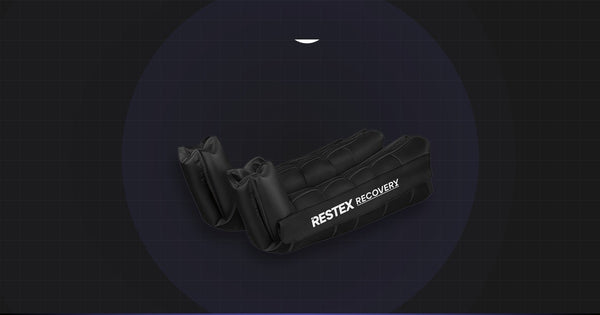
The Restex boots were built around the first three criteria on the list. Six overlapping chambers, an adjustable range of 40 to 260 mmHg, six preset programmes and a 10 to 90 minute timer. A 5,200 mAh battery giving 2 to 4 hours of use depending on programme and pressure, operation under 40 decibels, and a full-length zip.
Three sizes decided by inseam length: M up to 79 cm, L from 80 to 100 cm, XXL from 101 cm, with extensions at 34.90 euros a pair that add 10 cm of circumference when thigh circumference exceeds the limit for the size. CE, ISO and ROHS markings, 2-year warranty.
The price is 599.99 euros, with free delivery from 199 euros of purchase and 30 days to change your mind. The range is completed by accessories that plug into the same controller: Cryo inserts at 129 euros, arm sleeves, an abdominal belt and a Shoulder Duo at 349 euros.
See the Restex compression boots
Frequently asked questions about compression boots
Which compression boots should you choose?
The one whose chambers overlap rather than sit separately, whose pressure range is wide, in the order of 40 to 260 mmHg, and whose size matches your inseam length. Once those three points are settled, the rest is comfort of use and falls into line behind them: battery power, a noise level under 40 decibels, a zip, a 2-year warranty and CE, ISO and ROHS markings. The number of programmes and the size of the screen are not selection criteria.
What is the difference between compression boots and lymphatic drainage massage?
In the shops, "lymphatic drainage boots" and "compression boots" almost always refer to the same object: a sequential pneumatic compression device. The first expression stresses the intended effect, the second the technique. The real distinction concerns manual lymphatic drainage massage, performed by a practitioner with precise movements adapted in real time; a device mechanically reproduces the principle of progressive compression, less finely but repeatably, at lower cost and available at any hour.
How many chambers do compression boots need?
The number matters less than the arrangement. Six overlapping chambers, partially covering each other, beat eight separate ones: with overlap, no band of the leg is left without compression and the wave rises without interruption. If the information does not appear on the product page, ask the seller; a brand whose sleeves were designed with overlap says so in one sentence.
What pressure should you choose on compression boots?
Between 80 and 120 mmHg for the first two weeks, long enough to get used to the sensation, then 120 to 180 mmHg in everyday use depending on tolerance. That is why a wide range, up to 260 mmHg, is preferable: it leaves headroom to go higher. A device capped around 100 mmHg has nothing left to adjust after a month. Compression should stay firm without ever being painful.
How do you choose the size of compression boots?
By inseam length, measured standing with feet flat, from the floor up to the groin: M up to 79 cm, L from 80 to 100 cm, XXL from 101 cm. Thigh circumference does not choose the size, it sets a closure limit (66 cm in M, 71 cm in L, 75 cm in XXL). If the thigh exceeds that limit, you add extensions in the same size as the boot rather than going up a size, which would only add length. Between two bands, take the larger one.
What do compression boots cost?
From 150 euros to more than 2,500 euros. Under 200 euros you mainly find separate chambers, capped pressure, mains operation and a short warranty. Around 600 euros, the professional specifications without the cost structure of clinic equipment. The machines installed in salons cost 1,200 to 2,500 euros and are designed for intensive use all day long. Compared with a salon session at around 80 euros, a personal device at 599.99 euros becomes cheaper from the eighth session onwards.
Can you use compression boots every day?
Yes, as long as the session stays comfortable and there is no contraindication. A daily 20 to 30 minute session poses no problem and makes sense during hot spells or heavy training weeks. Three to four sessions a week are nonetheless enough to obtain a lasting effect: beyond that, the additional benefit is marginal.
Are compression boots covered by insurance?
Cover depends entirely on your country and on your insurer, so the only reliable answer is the one you get from your own policy. As a general rule, a device bought for wellness or sports recovery is not covered and needs no prescription. Cover, where it exists at all, is normally limited to compression care prescribed and supervised by a healthcare professional, with equipment specified for that purpose. If this matters to your decision, ask your insurer in writing before you buy.
What is the difference between a salon machine and home compression boots?
The technique is the same; what differs is the intensity of use it is built for. A salon device, at 1,200 to 2,500 euros, is built to run sessions all day with several users and professional servicing. A home device is aimed at three to four sessions a week for one person, with portability and quiet operation. For personal use, the price difference does not buy more effectiveness.
Read next: the complete guide to compression boots, at home or in a salon, how to choose, sequential or static compression and the size guide.

Bottes Restex Recovery.
Les techniques décrites dans cet article — 6 chambres chevauchantes, compression séquentielle, 30 minutes depuis votre canapé.
Discover the boots