
TL;DR:
- Sequential compression activates the muscle pump, improving circulation and muscle recovery.
- Static compression provides passive support, ideal for daily comfort and prevention.
- Effectiveness depends on context, regular use and an overall recovery strategy.
Many athletes wear compression socks after exercise thinking that any pressure aids recovery. This is partly true, but the reality is more nuanced. Between static compression and sequential compression, the mechanism is fundamentally different, and this is no small detail. One acts passively, the other actively reproduces the natural muscle pump. Understanding this distinction changes how you choose your recovery tools, and can make the difference between persistent heavy legs and genuine circulatory recovery after training.
Key takeaways
- Static compression applies constant, passive pressure (compression socks, sleeves) and supports the veins for daily comfort and prevention.
- Sequential compression inflates air chambers from ankle to thigh to actively reproduce the muscle pump, stimulating venous return and lymphatic drainage.
- Sequential compression is superior for active recovery after intense effort; static remains useful for prolonged daytime wear and travel.
- Effectiveness depends on context, applied pressure and regular use over several sessions, within an overall recovery strategy.
Understanding sequential and static compression
Before comparing their effects, you need to understand what each method actually does to your body.
Static compression includes compression socks, calf sleeves and compression knee braces. It applies constant, passive pressure to the tissues. This pressure doesn't vary over time: it remains identical from morning to evening. Its main role is to support the vein walls, limit swelling and reduce the sensation of heavy legs during wear. As soon as you remove the sock, the effect stops.
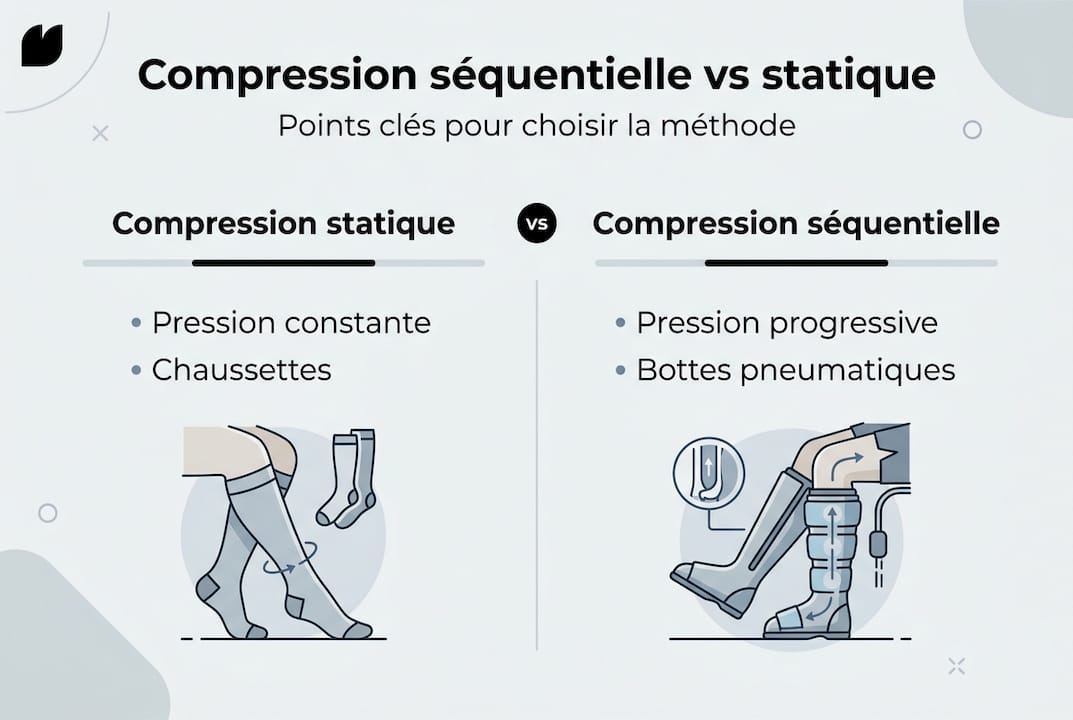
Sequential compression works on a radically different principle. Independent air chambers inflate and deflate in a specific order, from ankle to thigh, in several successive phases. This progressive movement mimics the natural muscle contraction that propels blood towards the heart. Compression boots from Restex Recovery use this mechanism with 6 chambers to cover the entire lower limb.
Here are the essential structural differences:
- Static compression applies fixed, passive pressure with no temporal variation
- Sequential compression creates active, dynamic mechanical flow, directed upwards
- Static is suitable for prolonged daytime wear
- Sequential is used in targeted recovery sessions (20 to 45 minutes)
- Sequential actively stimulates lymphatic drainage, static supports it passively
| Criterion | Static compression | Sequential compression |
|---|---|---|
| Type of pressure | Constant | Progressive and alternating |
| Mechanism | Passive | Active (mechanical pump) |
| Duration of use | All day | Short targeted sessions |
| Lymphatic drainage | Passive support | Active stimulation |
| Adjustable settings | None | Pressure, programme, duration |
Empirical studies on pneumatic compression show that PICT (intermittent sequential pneumatic compression) improves tissue perfusion and muscle elasticity, two effects that static compression doesn't produce comparably.
To explore recovery methods further, types of sports massage offer useful context for positioning compression within an overall strategy.
Pro tip: Adjust frequency according to your training load. In intense periods (3 to 5 sessions per week), a sequential compression session every two days is more effective than daily wear of compression socks.
Scientific evidence: what do studies say for athletes?
Research on compression has progressed rapidly in recent years. The results are encouraging, but deserve to be read with precision.
On sequential compression, the data is solid for certain profiles. PICT at 100 mmHg improves muscle elasticity at 48 hours post-exercise in combat sports athletes. This result is important: muscle elasticity directly conditions movement quality and injury risk during subsequent sessions.
But the effects aren't universal. In young football players, researchers didn't observe significant effects on certain neuromuscular markers with high-pressure compression. This means that exercise intensity, athlete profile and protocol used strongly influence results.
| Demonstrated benefit | Population concerned | Level of evidence |
|---|---|---|
| Improved muscle elasticity at 48h | Combat athletes | Strong |
| Reduced perception of tiredness | Endurance athletes | Moderate |
| Improved venous return | Sedentary and athletic adults | Strong |
| Reduced inflammatory markers | Variable depending on protocol | Moderate |
| Neuromuscular effects | Young footballers | Not demonstrated |
Sequential compression isn't a magic solution. It's a tool whose effectiveness depends on context, applied pressure and regular use.
What studies clearly confirm is the effect on circulation and drainage. For post-workout recovery, sequential compression accelerates the elimination of metabolic waste, including lactate, by mechanically stimulating lymphatic and venous flow. Static compression doesn't produce this active drainage.

The key message: sequential compression is superior for active recovery after intense effort. Static compression remains useful for prevention and daily comfort.
Practical uses: when to favour one over the other?
Now that the effects are clarified, here's how to choose according to your real profile.
Sequential compression is a priority for:
- Long-distance runners who string together outings and seek to reduce muscle soreness between training sessions
- Strength athletes (CrossFit, weightlifting) who experience significant muscle damage with each session
- Competitive athletes with heavy training cycles and little recovery time
- People suffering from chronic heavy legs who no longer respond sufficiently to compression socks
- Endurance athletes (triathlon, cycling, trail running) with daily sessions
Static compression remains suitable for:
- Extended office days after moderate exercise
- Long-distance plane or car journeys
- Preventing swelling in people standing all day
- Recreational athletes with low training frequency (1 to 2 times per week)
Sequential compression promotes mechanised drainage, but its real advantage depends on context of use. An athlete who trains twice a week at moderate intensity won't derive the same benefits as a triathlete in preparation phase.
For mixed profiles (regular sport and sedentary work), a combination of both approaches works well: compression socks during the day, sequential boots session in the evening after training.
To explore complementary methods, recovery massage fits naturally into this type of routine.
Pro tip: Don't judge the effectiveness of sequential compression after a single session. Test over 4 to 6 consecutive sessions before drawing conclusions. The cumulative effects on circulation and muscle recovery take time to establish.
Misconceptions and pitfalls to avoid with compression
Compression has become a popular subject on social media, and with popularity come exaggerations.
First misconception: the sensation of light legs after a session means you've recovered well. Not necessarily. This sensation is real and pleasant, but it doesn't guarantee complete muscle recovery. Muscle fibres damaged by exercise need time, protein and sleep, not just compression.
Second common mistake: believing that compression replaces an overall recovery strategy. It's just one element.
Empirical evidence remains mixed: sequential compression is mechanically more effective for active drainage, but it's not systematically superior in controlled trials versus rest alone or placebo.
What compression will never replace:
- Sleep: it's during the night that the majority of muscle regeneration occurs
- Hydration: without sufficient water intake, drainage is limited
- Protein nutrition: amino acids are the building blocks of muscle repair
- Active rest: light walking, mobility, gentle stretching remain essential
- Training progression: no recovery tool compensates for excessive training volume
Compression, sequential or static, is an accelerator. Not a substitute. Used in a coherent routine, it amplifies the effects of other practices. Used alone, its benefits remain limited.
Compression: what sports experts really remember
What most guides don't say is that compression doesn't work the same way for everyone, and that the most solid results come from regular, contextualised use.
An athlete who sleeps 6 hours, eats little protein and trains 6 days out of 7 won't gain much from 30 minutes of sequential boots. However, an athlete who develops their sports recovery methodically, combining nutrition, sleep and compression, will see tangible effects on their exercise tolerance and muscle freshness.
The other reality that experts highlight: benefits aren't always immediate. If you don't feel anything after two sessions, don't conclude that the method doesn't work for you. The physiological response to sequential compression builds gradually, especially for circulation and lymphatic drainage.
Every body reacts differently. Test, adjust the pressure, vary the programmes, and observe over several weeks. It's this personalised approach that distinguishes athletes who genuinely progress from those seeking the miracle solution.
Try compression adapted to your sports recovery
If this article has convinced you to go further with sequential compression, the Restex Recovery range is designed exactly for that. Restex compression boots use 6 independent chambers to cover the entire lower limb, from feet to thighs, with adjustable programmes and pressure levels according to your needs. Whether you're a runner, fitness enthusiast or simply seeking relief for your heavy legs, sequential technology adapts to your reality. Visit restexrecovery.com to explore the complete range and find the solution that matches your profile.
Frequently asked questions about sports compression
Is sequential compression more effective than static for recovering after exercise?
Studies show superiority on muscle elasticity at 48 hours post-exercise for sequential compression in contexts of intense effort, but the difference varies according to athlete profile and protocol used.
Is compression worthwhile if I do recreational sport?
The effect is less marked at low training frequency, but sequential compression can remain useful in cases of occasionally high loads or persistent post-exercise discomfort.
What pressure should be used to benefit from the effects of sequential compression?
Effective protocols revolve around 100 mmHg in sequential compression, but it's advisable to start at moderate pressure and adjust progressively according to your tolerance.
Can compression replace massage?
Compression is an effective complementary tool, but it doesn't replace overall recovery: manual massage, rest and nutrition remain indispensable pillars of an optimal routine.
The at-home solution
Restex Recovery Boots
Professional lymphatic drainage at home, without appointments. OptiFlow technology with 6 overlapping chambers, 6 programmes, quiet (<40 dB), wireless with 2 to 4 h battery life. CE/ISO/ROHS certified, 2-year warranty.

Bottes Restex Recovery.
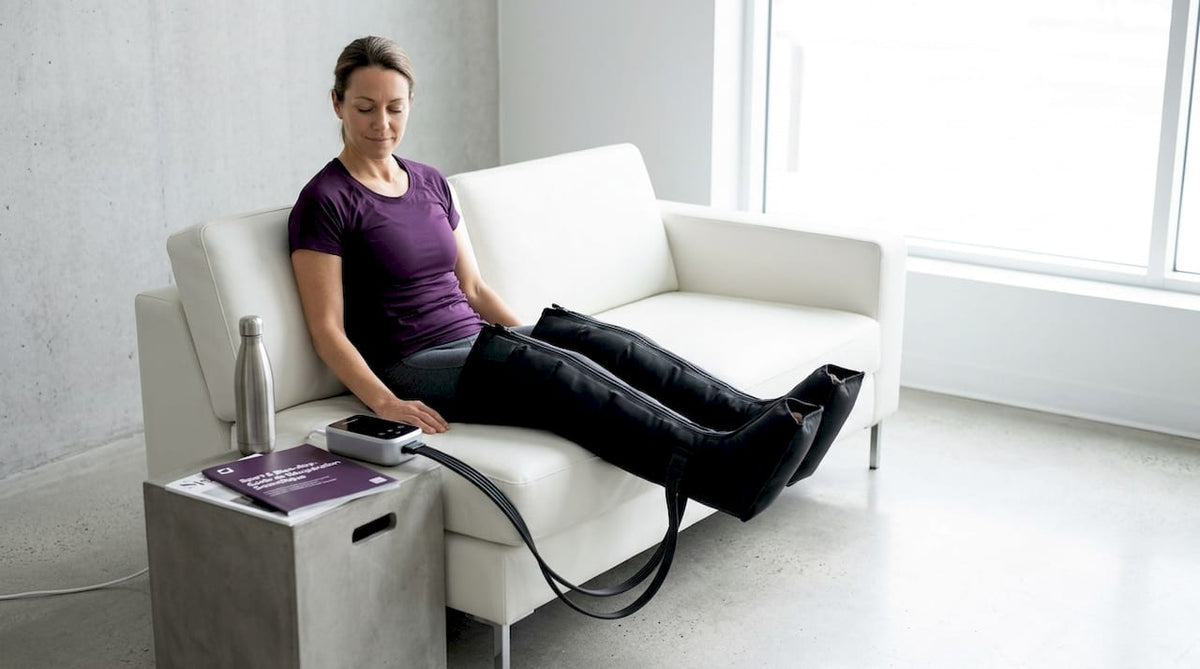
Les techniques décrites dans cet article — 6 chambres chevauchantes, compression séquentielle, 30 minutes depuis votre canapé.
Discover the boots