
Pressotherapy is winning over more and more people looking to relieve heavy legs, water retention and to speed up recovery. But one question always comes up: is it better to have your sessions at a clinic or to invest in your own pressotherapy boots at home? Let's compare the two options honestly — real costs, effectiveness, comfort — to help you choose the right one for your situation.
- The same principle on both sides: at home, a quality device produces the same mechanical effects as at a clinic.
- Cost: clinic ~€70–80/session; at home, a one-off investment then unlimited use — pays for itself in ~8 sessions.
- Buying criteria: 6 overlapping chambers, adjustable pressure 80–260 mmHg, several programmes, CE/ISO/ROHS certifications.
- How to choose: regular use + a controlled budget → at home; occasional need or follow-up by a professional → clinic.
Pressotherapy at a clinic or at home: what's the difference?
Quick answer: the technology is the same (sequential air compression that moves from the foot up to the thigh). The real difference is practical: at a clinic you pay per session by appointment; at home you own the device and use it whenever you want.
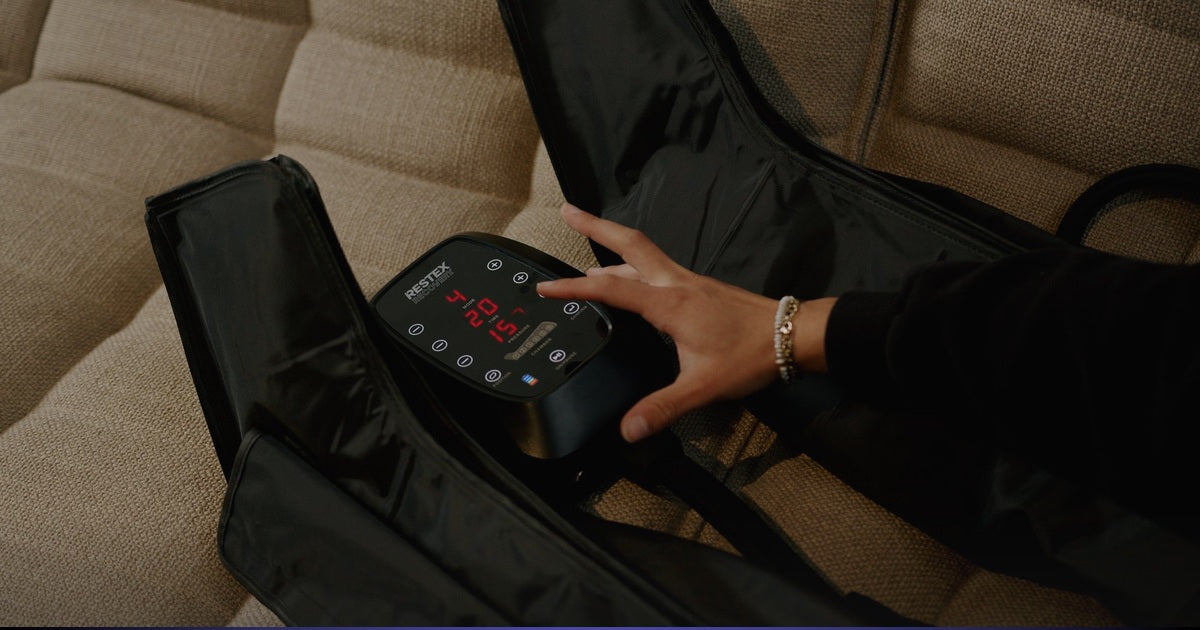
At a clinic, a practitioner fits boots connected to a compressor and runs a programme. At home, the Restex Recovery pressotherapy boots do exactly the same thing, on your own: you settle on the sofa and start your session. The lymphatic drainage action is identical; what changes is access and cost over time.
Is pressotherapy at home as effective as at a clinic?
Quick answer: yes — on two conditions: a quality device (overlapping chambers, sufficient pressure) and regular use. Consistency is in fact the advantage of doing it at home.
The effectiveness of compression depends mainly on the pressure applied and on consistency: studies show that suitable pressure reduces oedema more effectively1. And at home, you can do 3 to 4 sessions a week instead of one: the cumulative results are often better than a single weekly session at a clinic. Provided you choose a good device.
How much does it cost? The clinic vs home calculation
Quick answer: at ~€70 per session at a clinic, boots at home pay for themselves in about 8 sessions — after that, it's unlimited.
| Criterion | Clinic | At home (Restex) |
|---|---|---|
| Cost | ~€70–80/session | One-off investment, then unlimited |
| Return on investment | — | Paid off in ~8 sessions |
| Availability | By appointment | Whenever you want, in the evening |
| Consistency possible | ~1×/week | 3–4×/week |
| Pressure | Varies by clinic | Adjustable 80–260 mmHg |
"I used to spend €70 per session at my physio's. After 8 sessions my Restex boots had paid for themselves. Now I do a session whenever I want, on my sofa." — Caroline, verified customer review ★★★★★
Which technical criteria should you look at before buying?
Quick answer: aim for at least 6 overlapping air chambers, adjustable pressure up to 200 mmHg or more, several programmes, and medical certifications (CE, ISO, ROHS).
- 6 overlapping air chambers (OptiFlow technology): the overlap ensures continuous compression, with no "gap" as it moves up the leg — unlike non-overlapping chambers.
- Adjustable pressure 80–260 mmHg: gentle for light drainage, more intense for recovery.
- Several programmes (drainage, recovery, massage) to tailor the session to your needs.
- Battery life and comfort: rechargeable battery lasting 2 to 4 h, silent operation (< 40 dB), zip closures.
- CE, ISO, ROHS certifications and a warranty (2 years with Restex) — a sign of quality and safety.
At home or at a clinic: how to choose based on your situation?
Quick answer: if you plan to use it regularly and want to keep your budget under control, home wins. For a very occasional need or follow-up by a healthcare professional, the clinic still has its place.
| Your situation | Recommendation |
|---|---|
| Regular use (heavy legs, retention, sport) | At home — cost-effective and convenient |
| Very occasional need | A few sessions at a clinic |
| Medical follow-up / condition | Healthcare professional + medical advice |
| Tight budget over the long term | At home (quickly paid off) |
"I was looking for an alternative to drainage at a clinic. Within two weeks, my ankles had visibly gone down. So much more convenient than booking appointments." — Sandrine, verified customer review ★★★★★
Frequently asked questions
Is pressotherapy at home as effective as at a clinic?
Yes, with a quality device (overlapping chambers, adjustable pressure) and regular use. At home, the higher frequency (3–4×/week) often gives better cumulative results.
In how many sessions does the device pay for itself?
At around €70 per session at a clinic, boots at home pay for themselves in ~8 sessions. After that, use is unlimited.
Which pressure should you choose?
Start moderate (80–120 mmHg) for gentle drainage, then adjust. The Restex boots are adjustable from 80 to 260 mmHg.
How many sessions per week?
3 to 4 sessions of 20–30 minutes per week for visible, lasting results; start with 2 if you're new to it.
What should you check before buying pressotherapy boots?
The number and overlap of the chambers (ideally 6 overlapping), the maximum adjustable pressure, the programmes, the battery life, and the CE/ISO/ROHS certifications with a warranty.
So, at home or at a clinic?
If you plan to use pressotherapy regularly, home is almost always the best choice: the same technology, more flexibility, and a cost that's quickly paid off. The clinic remains relevant for an occasional need or medical support.
👉 Discover the Restex Recovery pressotherapy boots. Also worth reading: lymphatic drainage at home.
- Vanscheidt W, Ukat A, Partsch H. Dose-response of compression therapy for chronic venous edema — higher pressures are associated with greater volume reduction. J Vasc Surg. 2009;49(2):395-402.
- Assurance Maladie — Heavy legs and venous insufficiency (ameli.fr).

Bottes Restex Recovery.
Les techniques décrites dans cet article — 6 chambres chevauchantes, compression séquentielle, 30 minutes depuis votre canapé.
Discover the boots