
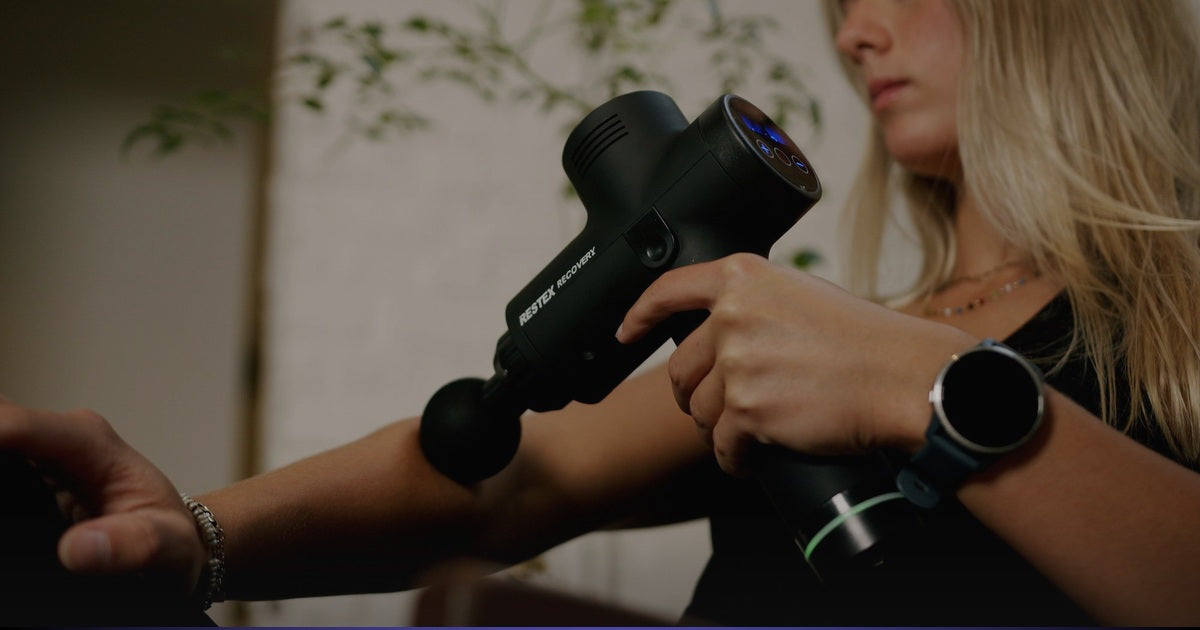
Massage Gun: Benefits, When and How to Use It for Optimal Recovery
The massage gun is increasingly talked about in the world of sport and wellbeing. Many people speak of its benefits for their recovery and quality of life — but what exactly is it, and is it really useful?
A massage gun is an electronic device that generates vibrations or percussions applied to muscles using an interchangeable massage head. Widely used by physiotherapists and sports coaches, it helps relieve muscle tension and improve blood circulation.

All athletes — from beginner to professional — benefit from massage in their recovery process. A post-workout massage helps recover from intense training, reduces muscle soreness and improves blood circulation.
Not all massages are equal: it all depends on the duration, the pressure applied and the timing chosen. This is where the massage gun stands out: it allows you to adjust the intensity, duration and timing of each session — and you can take it everywhere. No more costly physiotherapist sessions for every recovery.
Here are the main benefits of using a massage gun correctly:
1. Myofascial release and reduction of muscle soreness (DOMS)

DOMS (Delayed Onset Muscle Soreness) can truly hamper your training. This pain typically appears 24 to 48 hours after intense effort and can last up to 5 days. Massage gun therapy can significantly reduce this pain and help you return to activity more quickly.
Vibratory therapy is particularly effective for myofascial release. Many athletes suffer from contracted fascia due to the volume and intensity of their training. Releasing these fascia provides significant relief and improves flexibility — which, in turn, optimises muscle performance and greatly reduces muscle soreness.
Percussion therapy, offered by the massage gun, acts directly on muscle tissue with greater amplitude than simple vibration, offering potentially more targeted and effective results.
2. Injury prevention

Massage is an excellent tool for preparing muscles for effort and activating blood circulation, thus ensuring sufficient oxygen supply to the muscles.
Used as a warm-up, it helps raise body temperature, wake up the body and increase flexibility — which significantly reduces the risk of injury.
3. Post-injury care and rehabilitation

Massage gun therapy is particularly valuable for athletes and people undergoing rehabilitation. It helps accelerate recovery by stimulating blood circulation in the injured area and improving mobility without aggravating the injury.
This is why many physiotherapists integrate the massage gun as a primary tool in treating their patients.
4. Stress reduction and muscle relaxation

Reducing physical tension and tiredness produces deep mental relaxation — a true secondary benefit of a good massage. Not everyone has access to a professional massage therapist at all times. This is where the massage gun comes into its own: usable anywhere and at any time, it significantly improves the recovery process, allowing the athlete to train harder and achieve more during each session.
5. Performance improvement and stimulation of lymphatic circulation

When athletes train day after day with stiff, painful and exhausted muscles, reaching optimal performance becomes almost impossible. Before progressing, the body must first recover — and post-workout massage directly contributes to this.
Massage reduces muscle tiredness by improving blood circulation and facilitating tissue fluid exchange. It also stimulates venous and lymphatic circulation, promoting the elimination of metabolites and toxins, and allowing an influx of fresh blood, rich in nutrients and oxygen, to the muscles.
The athlete thus requires less recovery time between sessions. It's important to remember that massage must be accompanied by appropriate nutrition and sufficient sleep to minimise muscle tiredness and prevent injuries.
When to use a massage gun?

As a general rule, the ideal window for post-workout massage is between 1 and 6 hours after intense exercise, difficult training or competition. The body returns to its base temperature and cardiovascular functions in about 1 hour, and muscle stiffness appears around the 6th hour. Massage within this window is most beneficial.
Massage should cover all the muscle groups worked — not just painful areas — in order to facilitate rapid recovery and strengthen muscle resilience.
How long should each massage session last?

During competitions over several consecutive days, a thorough but brief massage is recommended after each effort. The more frequently and intensely the athlete trains, the more regular massage sessions should be.
Each athlete responds differently to massage and must adapt their recovery individually. We recommend using a massage gun as a warm-up to relax muscle fascia and activate circulation in connective tissues. For post-training massage, take more time, focusing particularly on tense areas that require more work.
Important points for your first use
- Do not use on bony areas (joints, spine, neck, fractures)
- If pain is too intense, reduce pressure or speed — always adapt to personal tolerance threshold
- Do not use on areas with reduced or altered sensation
- Avoid wounds and burns of any kind
- Avoid areas where superficial nerves pass
- Read the user manual before any first session
By following this advice, you'll be able to optimise your recovery to train more and reach your goals faster.
Is percussion therapy safe?

Absolutely. Massage gun therapy is one of the most effective methods for muscle recovery. The essential thing is to use the device correctly and, in case of doubt about your physical condition or a specific injury, to consult a healthcare professional before using it.
Conclusion: is the massage gun worth the investment?

As you can see, the benefits of the massage gun far outweigh the constraints or disadvantages. By following the usage recommendations and choosing a quality device, you have a performance tool in the palm of your hand — to use anywhere, anytime.
The massage gun also comes as an ideal complement to other recovery devices. For even more complete recovery — particularly for heavy legs, water retention or lymphatic circulation — discover our Restex Recovery pressotherapy boots. Designed to offer professional lymphatic drainage at home, they perfectly complement the action of the massage gun on the whole body.
Massage gun and pressotherapy boots: two complementary approaches
The massage gun and pressotherapy boots act on different but complementary mechanisms. The gun targets localised muscle tension through percussion — it's ideal for knots, trigger points and myofascial release. Pressotherapy boots work on the entire legs through sequential compression, promoting lymphatic drainage and venous return.
The ideal post-workout protocol:
- Massage gun (5-10 min) — target tension areas: quadriceps, calves, hamstrings
- Pressotherapy boots (20-30 min) — global leg drainage, elimination of metabolic waste
- Hydration — 500ml of water to facilitate elimination
This combination offers both targeted relief of tension and deep drainage of the entire lower limbs. It's the approach used by many physiotherapists and professional sports teams.
To go further:
- Muscle recovery: complete guide for amateur athletes
- Pressotherapy vs manual massage: complete comparison
- Running recovery and pressotherapy
FAQ — Frequently asked questions about massage guns
When should I use a massage gun?
The best time is between 1 and 6 hours after intense effort. The body returns to its base temperature in about 1 hour, and muscle soreness appears around the 6th hour. Massage within this window is most beneficial for muscle recovery.
How long should a massage gun session last?
Duration depends on the objective. As a pre-training warm-up, a short session is enough to wake up the muscles. For post-training recovery, take more time on tense areas, adapting the frequency to the intensity of effort.
What's the difference between percussion therapy and vibration therapy?
Both use the same basic mechanism, but percussion therapy acts directly on muscle tissue with greater amplitude. This gives it the potential for more targeted and more intense results than simple vibration.
Is percussion therapy safe?
Yes, when used correctly. Avoid bony areas, wounds or burns, and areas with reduced sensation. In case of doubt about an injury or particular condition, consult a healthcare professional before use.
Complete your recovery
Restex Recovery Pressotherapy Boots
Professional lymphatic drainage at home. 6 OptiFlow chambers, 6 programmes, quiet, rechargeable. CE/ISO certified. 2-year warranty.
Discover the boots →
Bottes Restex Recovery.
Les techniques décrites dans cet article — 6 chambres chevauchantes, compression séquentielle, 30 minutes depuis votre canapé.
Discover the boots