
TL;DR:
- Recovery after a mountain trail run requires a structured 72-hour protocol to prevent injuries and stagnation.
- Immediate actions include recovery walking, rehydration, targeted nutrition, and changing clothes.
- Effective recovery relies on sleep, anti-inflammatory diet, cold baths, compression, and listening to your body.
Crossing the finish line of a mountain trail run is far more violent on the body than completing a simple road run. The elevation gain, repeated impact on descents, and prolonged duration create a level of muscle microtrauma that many trail runners underestimate. The result: improvised recovery that stretches into persistent soreness, recurring injuries, and stagnating performance. This 72-hour protocol gives you a clear roadmap, hour by hour, to repair your muscles faster, prevent injuries, and return to training in the best possible condition.
Table of Contents
- Understanding the importance of post-trail recovery
- Immediate protocol (0-2h): post-race management
- The first 24 hours: sleep, nutrition, inflammation
- From 24 to 72h: listening to your body and smart resumption
- What trail runners often forget after a trail run
- Optimise your recovery with adapted solutions
- Frequently asked questions about post-trail recovery
Key Points
| Point | Details |
|---|---|
| Structured 72h protocol | Following a 4-phase protocol optimises muscle repair and limits injury risks after a trail run. |
| Targeted nutrition | Combining carbohydrates/proteins and anti-inflammatories within 24h accelerates recovery. |
| Rest and mobility | Alternating deep sleep, hydration, gentle mobility, and active recovery promotes safe return to training. |
| Listening to your body | Adapting resumption according to tiredness, pain, and individual recovery guarantees sustainable progress. |
Understanding the Importance of Post-Trail Recovery
A mountain trail run isn't just a long outing. It's an accumulation of eccentric contractions, particularly in the quadriceps during descents, repeated vibrations on the joints, sustained cardiorespiratory demand over several hours, and often significant dehydration. All of this creates far deeper muscle damage than during regular training.
DOMS (delayed onset muscle soreness), these delayed muscle pains, reach their peak between 24 and 48 hours after exertion. Complete repair of muscle fibres for major muscle groups takes between 48 and 72 hours, or even longer depending on the distance covered. The empirical rule is simple: count approximately one day of recovery for every 10 km run. A 40 km trail therefore requires around 4 days minimum before considering a serious return to training.
Ignoring these facts means playing against yourself. Here's what happens concretely when recovery is botched:
- Damaged muscle fibres don't fully recover, weakening tendons and ligaments
- The immune system remains suppressed for several days, increasing infection risk
- Central nervous system fatigue persists and slows proprioceptive reflexes
- Joint pain becomes established if inflammation isn't managed properly
- Progress stagnates because muscle adaptations cannot take place
The post-exercise metabolic window is real and time-limited. During the first hours, your muscle cells are particularly receptive to nutrients to initiate reconstruction. Every hour lost in this window slows the muscle protein synthesis process.
| Recovery phase | Duration | Primary priority |
|---|---|---|
| Immediate recovery | 0 to 2h | Rehydration, carbohydrate and protein intake |
| Short-term recovery | 2 to 24h | Sleep, anti-inflammatory nutrition |
| Intermediate recovery | 24 to 72h | Gradual resumption, listening to signals |
| Complete recovery | 72h to 15 days | Return to training according to distance |
Trail runners who structure their recovery see a significant reduction in their soreness, better sleep quality within 48h, and earlier resumption of training without residual pain. The next section gives you the concrete actions to take as soon as you cross the finish line.
Immediate Protocol (0-2h): Post-Race Management
Your body has just taken a hit. This isn't the time to lie down directly or celebrate the finish without transition. The first 120 minutes are crucial for the quality of your recovery over the following 72h.
Step 1: recovery walk (0 to 15 minutes)
As soon as you cross the finish line, walk slowly for 10 to 15 minutes instead of sitting immediately. This simple action accelerates venous return, helps eliminate accumulated lactic acid, and avoids abrupt blood pressure drops. Many trail runners collapse onto a chair immediately: that's exactly what you shouldn't do.
Step 2: intelligent rehydration (0 to 30 minutes)
Plain water isn't enough. You've lost electrolytes, particularly sodium, potassium, and magnesium, through sweating for several hours. Start with a drink containing electrolytes. Avoid industrial sugary drinks and favour mineralised water or a specialised recovery drink.
Step 3: metabolic window (30 to 120 minutes)
This is where everything plays out nutritionally. Exploit the metabolic window to recharge your glycogen stores and initiate protein synthesis.
| Nutrient | Target quantity | Food examples |
|---|---|---|
| Carbohydrates | 1 to 1.2 g per kg of body weight | Banana, rice, bread, dates |
| Proteins | 3:1 carbohydrate/protein ratio | Cottage cheese, chicken, eggs |
| Water | 150% of estimated losses | Mineral water, salted broth |
For a 70 kg trail runner, this represents approximately 70 to 85 g of carbohydrates and 25 to 30 g of protein in the first 2 hours.
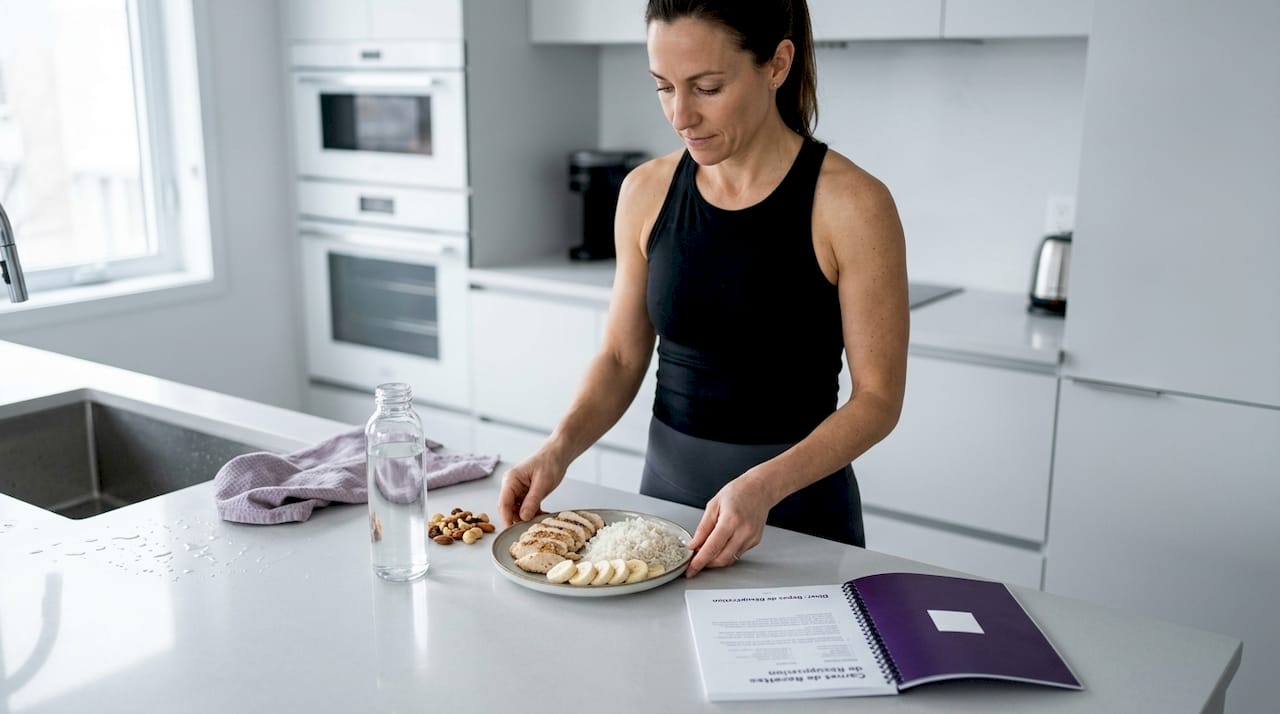
Step 4: changing clothes and gentle mobility
Immediately change your damp clothing to avoid sudden cooling and hypothermia risks at altitude. Follow with 5 to 10 minutes of gentle mobility: ankle circles, hip rotations, light calf stretches. No deep stretching, just fluid movements to restart circulation.
Pro tip: prepare a recovery bag in advance with dry clothes, an electrolyte drink, a recovery snack (like banana purée and cottage cheese), and a pair of compression socks. You'll have everything on hand without having to think after the race.
Consult our post-workout recovery guide to deepen techniques for active recovery adapted to intense mountain efforts.
The First 24 Hours: Sleep, Nutrition, Inflammation
Once home, the absolute priority is sleep. Not social media, not analysing your GPS watch, not a copious celebratory meal. Sleep.
During sleep, your body releases growth hormone at elevated levels, which is directly responsible for muscle repair. Aim for 8 to 10 hours of sleep the night following your trail run. If possible, slightly elevate your legs during rest to facilitate venous return and reduce swelling.
Anti-inflammatory nutrition for the first day
Your meals for the day should be rich in:
- Complex carbohydrates: brown rice, sweet potato, oats to recharge muscle glycogen
- Lean proteins: poultry, fish, legumes for fibre reconstruction
- Anti-inflammatory foods: turmeric, ginger, berries, sardines rich in omega-3
- Antioxidants: colourful fruits, green vegetables to counter oxidative stress
"Aiming for 8 to 10 g of carbohydrates per kilogramme of body weight on the post-trail day isn't a luxury, it's a biological necessity for your muscles to recover and rebuild properly."
Monitor the colour of your urine: pale like lemonade is a good sign. Dark, drink more. It's the simplest and most reliable indicator of your hydration.
Ice baths and contrast showers
A cold bath at 12-15°C for 10 to 15 minutes can reduce inflammation and muscle pain. It's not pleasant, but the effectiveness is real. If an ice bath seems too difficult, alternate hot shower (2 minutes) and cold (30 seconds) for 3 cycles. The vasoconstrictor/vasodilator effect stimulates circulation.
First compression session: the ideal moment
Between the 6th and 12th hour post-race is the time to integrate a pressotherapy session. Six-chamber compression boots work in sequence from the foot to the thigh to drain accumulated toxins, reduce swelling, and restart lymphatic flow. Allow 30 minutes. Athletes who use pressotherapy after running regularly report a notable decrease in heavy leg sensations from the end of the session.
Pro tip: absolutely avoid deep massages in the first 24 hours. Muscle fibres are micro-lesioned and excessive pressure can worsen the damage. Light foam rolling on quadriceps, calves, and glutes is acceptable, but stay well below the pain threshold.
From 24 to 72h: Listening to Your Body and Smart Resumption
After the first 24 hours, your body sends you precise signals. It's up to you to interpret them correctly.
Warning signs to monitor absolutely
Certain signs indicate that recovery isn't proceeding as planned and you need to ease off even more:
- Persistent tiredness that doesn't decrease despite sleep
- Resting heart rate still elevated (more than 5 to 7 bpm above your normal)
- Sleep disturbances: frequent night wakings, difficulty falling asleep
- Localised joint pain, distinct from diffuse soreness
- Marked irritability or concentration difficulties
These signals indicate an overload state requiring at least one additional complete rest day.
Mountain trail specificity: quadriceps focus
Mountain trail running imposes extremely high eccentric work on the quadriceps during descents. These contractions, where the muscle lengthens under tension, create the most severe micro-lesions. DOMS reach their peak between 24 and 48h, and complete fibre repair can require an additional 48 to 72h for these large muscle groups.
Day 2: light walking and second compression session
On day 2, if you don't feel acute pain, a light 20-minute walk is ideal. No running, no intense cycling. Just a walk at conversational pace to gently restart circulation without recreating mechanical stress on the repairing fibres.
It's also time for the second sequential compression session, again 30 minutes, with the boots in drainage mode. Studies on post-exercise sequential compression show a significant reduction in DOMS among endurance athletes, which translates concretely into lighter leg sensations and improved mobility the next day.
Eat similarly to day 1: rich in protein, anti-inflammatories, well hydrated.
Day 3: gentle mobility and resumption decision
On day 3, incorporate a 15 to 20-minute mobility session: gentle yoga, joint mobilisations, moderate stretching. Honestly assess residual pain. If your quadriceps, calves, or ankles are still tender to palpation, wait another 24h before any resumption of running.
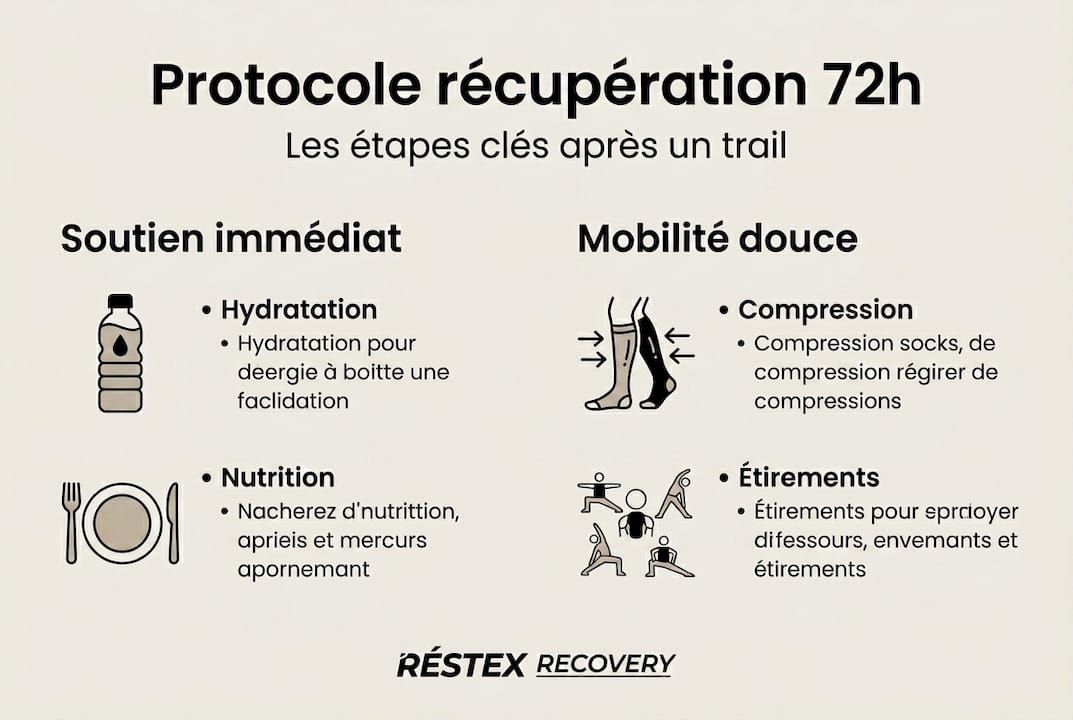
Gentle mobility protocols that integrate a circulatory dimension, such as standing exercises with heel raises or dynamic ankle circles, significantly accelerate return to full mobility.
Pro tip: keep a recovery journal. Note each morning your heart rate on waking, your sleep quality out of 10, your pain out of 10, and your general energy level. After three races, you'll have a personalised recovery profile that will allow you to adjust your protocol precisely.
What Trail Runners Often Forget After a Trail Run
Here's a truth few articles dare formulate: the majority of amateur trail runners aged 28 to 45 recover "roughly" but not "in detail". They sleep, eat, wait until they're no longer in pain, and resume. This isn't structured recovery. It's simply waiting for it to pass.
The problem is that data shows structured 72-hour recovery accelerates tissue repair, reduces overtraining injury risk, and improves performance during subsequent outings. Positive muscle adaptations are built precisely in this space between effort and resumption.
The most frequent error is optimism about resumption. You feel better on day 2, so you run. But "feeling better" isn't the same as "being repaired". Deep muscle fibres and tendons need time that your surface sensations don't yet reflect.
Distinguish normal fatigue, which progressively decreases, from persistent tiredness that doesn't respond to rest. The former is physiological. The latter is a signal. Learn to know your individual recovery profile. It's as unique as your stride.
Optimise Your Recovery with Adapted Solutions
Anne-Lise Rousset, world trail medallist, French champion, and Skyrunner World Series competitor, incorporates Restex Recovery boots into her post-race recovery routine. Why? Because six-chamber sequential compression reproduces, at home, what the best professional recovery centres do.
Our Restex compression boots work from foot to thigh to drain, restart, and regenerate your tired muscles, in 30 minutes per session. Two sessions within 48h post-trail is our recommended Restex trail protocol.
Recover faster after your next trail run with Restex. Discover our boots and our compression programme adapted to trail runners.
Frequently Asked Questions About Post-Trail Recovery
What is the best food to recover after a trail run?
A meal combining complex carbohydrates, lean proteins, and anti-inflammatory foods promotes optimal recovery, with a target of 8 to 10 g of carbohydrates per kilogramme of body weight over the day.
Why avoid deep massages within 24h?
They risk worsening the muscle micro-lesions created during the trail run: avoid deep pressure and favour light foam rolling on quadriceps, calves, and glutes.
When can you resume running after a trail run?
Wait for pain to disappear and absence of persistent tiredness: count 1 day per 10 km covered, meaning 2 to 3 days for a short trail and up to 7 to 15 days for long formats.
Is cryotherapy really useful after a trail run?
Yes, a cold bath at 12-15°C for 10 to 15 minutes can reduce inflammation and muscle pain, particularly effective in the first 24h post-race.
Recommendation
```
Bottes Restex Recovery.
Les techniques décrites dans cet article — 6 chambres chevauchantes, compression séquentielle, 30 minutes depuis votre canapé.
Discover the boots